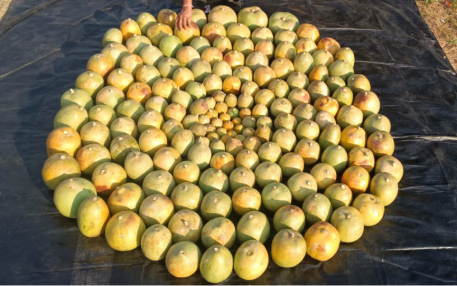
Bael (Aegle marmelos) is an indigenous fruit of the Indian subcontinent and belongs to the family Rutaceae. It is considered one of the sacred trees in Hinduism, as its trifoliate leaves are traditionally offered to Lord Shiva. For this reason, it is also known as the “Tree of Shiva.” In addition to its religious significance, Bael is highly valued for its medicinal properties.
Bael is believed to have originated in the Eastern Ghats and Central India. Being native to the Indian subcontinent, it is mainly found in tropical and subtropical regions. The tree grows naturally in the lower ranges of the Himalayas up to an elevation of about 500 meters and is widespread in Jharkhand, Madhya Pradesh, the Deccan Plateau and along the East Coast (Sharma et al., 2007).
Bael is also widely distributed outside India, occurring in China, Nepal, Sri Lanka, Myanmar, Pakistan, Bangladesh, Vietnam, Laos, Cambodia, Thailand, Indonesia, Malaysia,
Tibet, Philippines and Fiji.
| Botanical Classification | |
| Kingdom: | Plantae |
| Division: | Magnoliophyte |
| Class: | Magnoliopsida |
| Order: | Sapindales |
| Family: | Rutaceae |
| Genus: | Aegle |
| Species: | marmelos |
| Botanical Name: | Aegle marmelos |
Requirements –
Soil – Bael can be grown in a wide range of soils, however, loamy soil with good drainage and proper aeration is most suitable.
Soil pH – The ideal pH range is 5.5 to 7.5, though the crop can tolerate values as low as 4.0 and as high as 8.5.
Temperature – The optimum temperature for good crop is 25–32°C, with a tolerance of up to 45°C.
Elevation – Bael can be cultivated successfully up to 500 meters above mean sea level.
Climate – Being hardy in nature, it performs well under dry, semi-arid, and subtropical conditions.
Irrigation Water – For successful cultivation, the electrical conductivity (EC) of irrigation water should 4 – 6 dS/m, though the crop can tolerate salinity up to 9 dS/m but this will result poor productivity of the plant.

| Nutritional Composition (Per 100 G) | ||
| Nutrients | Unit | |
| Carbohydrate | g | 31.8 |
| Fat | g | 0.39 |
| Protein | g | 1.8 |
| VIT B1 | mg | 0.13 |
| VIT B2 | mg | 1.19 |
| VIT B3 | mg | 1.1 |
| VIT C | mg | 8.0 |
Source: (Akath et al., 2015)
| Health Benefits |
| Bael juice controls gastric ulcers caused due to the imbalance of mucosa and levels of oxidative stress in the gastric tract. |
| Bael juice is a powerhouse of vitamin C that boost immunity and prevent infections from bacteria and viruses. |
| Bael fruit contain antioxidants helps to control cholesterol, fight against heart disease and reduce the cancer risk. |
The Package of practices are prepared in following order –
– Care of Young Plants Before Plantation
– Plantation Earthing Up Level
– Drip Laterals & Its Placement
– Staking
– Removal of Tape From Graft Union
– Training
– Pruning
– Grading
– Diseases
Source –
- Breeding of Horticultural Crops Vol. 2 (Eds. V A. Parthasarathy, Sanjay Kumar Singh, S. Vinoth, Vikas Yadav (pp.35-57)
- Singh, A. K., Singh, Sanjay, Saroj, P. L. (2018). The Bael (Production Technology). Technical Bulletin No. CIAH/Tech./Pub. No. 67 published by Director, ICAR-CIAH, Bikaner. p. 1-55