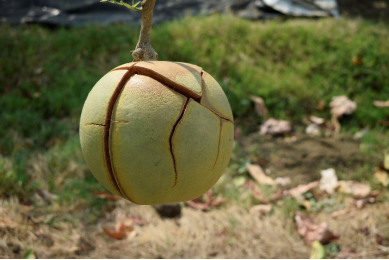
Fruit cracking is a significant physiological disorder in Bael. The extent of damage varies according to genotype, variety, and location.
This disorder typically occurs twice a year:
During the winter (December–January), affecting immature developing fruits.
In the summer (March–April), when fruits are mature and approaching ripeness.
Cracking that occurs during the fruit’s ripening stage is generally more severe than the cracking seen in immature fruits.
Causes of Fruit Cracking
Fruit cracking in bael is primarily caused by a physiological imbalance where the fruit’s skin (epidermis and cuticle) cannot keep pace with rapid internal growth or increased water uptake. This imbalance results in the skin rupturing under pressure.
Key Contributing Factors:
Rapid Water Accumulation: Excessive water uptake inside the fruit, often due to heavy rainfall or over-irrigation following a dry spell, raises the internal turgor pressure beyond the skin’s capacity to stretch. This commonly leads to fruit splitting.
Environmental Fluctuations: Variations in humidity, temperature, and soil moisture play a significant role. For example, high temperatures and low humidity followed by sudden heavy rains can harden the fruit’s skin and lessen its elasticity. If the internal tissues, then expand more quickly than the skin can accommodate, the cracking occurs.
Micronutrient Deficiencies (Boron & Calcium):
- Boron Deficiency: Boron plays a critical role in pectin synthesis and cell wall cross-linking (forming rhamnogalacturonan-II complexes). Deficiency weakens cell wall integrity, making the rind brittle and highly prone to rupture.
- Calcium Deficiency: Calcium forms calcium pectate in the middle lamella, maintaining structural rigidity and elasticity in expanding peel tissues.
Genetic Susceptibility: Certain cultivars are more prone to fruit cracking because they possess a weaker or thinner cuticle layer, reducing their ability to withstand internal pressure.
Biochemical and Enzymatic Changes: As fruit ripens, biochemical changes decrease the flexibility and mechanical strength of the skin. Enzymatic processes can alter the integrity of cell walls and cuticle layers, further increasing the fruit’s vulnerability to cracking.
Managing fruit cracking requires a combination of moisture conservation, wind protection, balanced plant nutrition, and targeted micronutrient sprays.
| Management Category | Recommended Practice | Mode of Action & Benefits |
| Soil Moisture Management | Regular Irrigation Intervals: Maintain an optimum soil moisture regime during peak fruit development (October to April). Avoid prolonged dry spells followed by heavy flood irrigation. | Prevents sudden surges in internal fruit turgor pressure. |
| Organic Mulching | Basin Mulching: Apply organic mulches such as paddy straw, maize straw, or dry leaves @ 10–15 thickness within tree basins. | Conserves soil moisture, suppresses evaporation, keeps the root zone cool, and buffers against soil temperature spikes. |
| Windbreak Establishment | Shelterbelts: Plant fast-growing tall trees (e.g., Neem, Casuarina, or Rosewood) on the windward side of the orchard. | Shields bael trees from hot, desiccating summer winds (Loo), reducing pericarp desiccation and hardening. |
| Nutritional & Foliar Sprays | Borax Spray: Foliar spray of Borax @ 0.5–0.6% (5–6 g/L) or Boric Acid @ 0.3% during fruit development (May–June and September). | Enhances cell wall pectin binding, improves rind elasticity, and reduces cracking rates significantly. |
| Nutritional & Foliar Sprays | Calcium & Zinc Application: Combined spray of Calcium Nitrate @ 0.5% (5 g/L) + Zinc Sulphate @ 0.5%. | Strengthens the middle lamella in pericarp cells and aids hormone synthesis for uniform growth. |
| Resistant Varieties Selection | Grafted Cultivars: Plant cultivars showing lower cracking incidence under arid/semi-arid conditions (e.g., Narendra Bael-5, Pant Shivani). | Offers higher genetic tolerance against stress-induced cracking. |
References:
- Singh, A. K., Singh, S., & Saroj, P. L. (2018). The Bael: Production Technology and Management of Physiological Disorders. ICAR – Central Institute for Arid Horticulture (CIAH), Bikaner, Technical Bulletin No. 68.
- Supports: Bi-annual occurrence patterns (Winter vs. Summer cracking), environmental humidity stress, mulching protocols, and cultivar susceptibility.
- Davila-Elcarte, O., et al., (2025). The Effect of Boron on Fruit Quality and Cell Wall Integrity: A Review. Horticulturae, 11(8), 992. https://doi.org/10.3390/horticulturae11080992
- Supports: Biochemical role of Boron (pectin binding) and Calcium (middle lamella strength) in mitigating pericarp cracking in Aegle marmelos and other Rutaceae fruit crops.
- Mishra, R., & Kumar, S. (2023). Mitigating Fruit Cracking and Premature Dropping in Bael (Aegle marmelos) cv. NB-9 under Subtropical Conditions: Evaluating the Effects of Bio-formulations and Boric Acid. ResearchGate Bulletin, Dept. of Fruit Science, ANDUAT, Ayodhya.
- Singh, A. K., et al., (2023). Variability for Phenological Traits and Fruit Yield Attributes in Bael (Aegle marmelos Correa) Cultivars under Semi-Arid Conditions. International Journal of Crop Breeding and Genetics, 121–126.