Citrus Leaf Miner (Phyllocnistis citrella Stainton)
What is Citrus Leaf Miner?
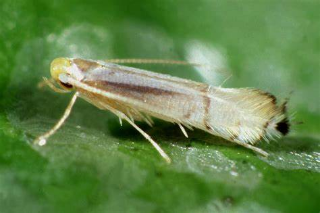
The Citrus Leaf Miner (CLM), Phyllocnistis citrella Stainton, is a micro-lepidopteran moth in the family Gracillariidae. Its larvae feed exclusively inside the epidermal layers of young, tender citrus foliage, creating characteristic serpentine mines. Left unmanaged, CLM retards young tree growth, increases susceptibility to Citrus Canker (Xanthomonas citri), and severely impacts overall health of the plant.
Life Cycle of Citrus Leaf Miner –
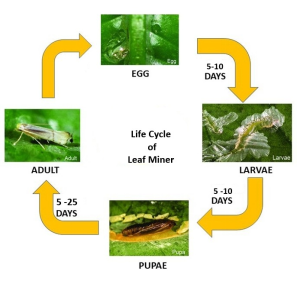
(Life Cycle – 30 – 60 Days)
Egg:
- The female lays eggs singly on the lower side of newly emerging leaves, mainly near veins or midribs. A female can lay up to 50 -70 eggs during her lifespan. Eggs are dome-shaped and nearly translucent, hatching into neonate larvae after 5–10 days.
Larvae:
- Larvae are about 3 mm long and have a translucent greenish-yellow appearance. There are four larval instars:
- The first three instars feed on the epidermal cells just below the transparent cuticle.
- The fourth instar does not feed but produces silk to form a pupal chamber.
- The larval stage lasts 5-10 days and is the most destructive stage for citrus leaves.
Pupae:
- Pupation occurs within the mines near the leaf margin, usually under a slight curl of the leaf. The pupal stage lasts 5-25 days, depending on temperature, after which adults emerge, typically in the morning.
Adult:
- The adult citrus leaf miner is a small, delicate moth about 2 mm long. It is silver and yellow-brown, with a distinctive black dot at the tip of the forewing. Adults are mostly active at dusk and hide in foliage during the daytime.
How does it damage the plant?
- The larval stage is the most damaging, as larvae use their sharp, blade-like mandibles to pierce cell walls and feed on epidermal cell sap.
- This feeding produces serpentine mines, which are filled with larval excreta. Mines usually extend to the leaf edges, where larvae roll the leaf to protect the pupal chamber.
- Infested leaves become deformed, curl, and may eventually defoliate.
- Both young and mature trees are affected, but damage is more severe in young plants.
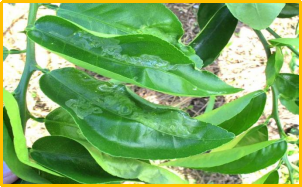
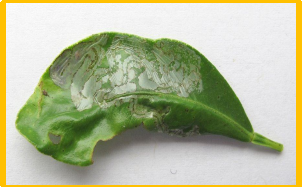
Fig – Symptoms of leaf miner
Severe Infection Period-
Usually leaf miner is more active during their growth period i.e., in spring and rainy seasons (Feb – March; June – July; October- November @ Raipur Condition).
Management-
| Mechanical and Cultural Practice | Biological Control | Chemical Control |
| Avoid pruning during the tree’s active growth period, as this can attract CLM infestation.Prune water shoots and rootstock suckers which act as primary breeding grounds for adult egg-laying.Remove and destroy affected leaves at the early stage of infestation to prevent further spread.Collect and destroy fallen leaves and pruned material to minimize overwintering or surviving larvae. affected portion.Avoid excessive nitrogen fertilization during high-pest periods to prevent continuous vegetative flushes. | No predation of citrus leaf miner is known to occur. Spraying of Verticillium leccani @ 5 ml per liter at the time of the emergence of new leaves may control the leaf miner. | Foliar application: The insect can be satisfactory controlled by spraying: Abamectin 2% EC @ 1 ml per liter of water or Spinosad 45% EC @ 1 ml per liter of water. Cyantraniliprole 10.26% OD @ 1.5ml/litre of water. |