Causal Organism – Thelaviopsis sp. and Sclerotium sp.
Symptoms
- Wilting of foliage: Leaves may wilt suddenly, often starting from the tips and progressing downward.
- Yellowing of leaves: Older leaves may turn yellow before wilting and dropping.
- Stunted growth: Infected trees often show reduced growth and vigor.
- Root decay: Roots become brown or black, soft, and rotted; fine feeder roots may disappear.
- Vascular discoloration: Cutting the main roots or lower stem may reveal brown or black streaks in the vascular tissue.
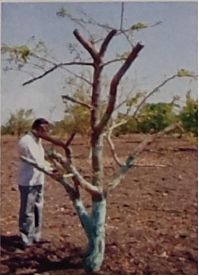
- Dieback of branches: In severe cases, branches die back, sometimes leading to partial canopy loss.
- Poor fruiting: Trees affected by root rot may produce smaller, fewer, or malformed fruits.
- Fungal structures: In some infections, mycelial mats or fungal sporulation may be visible on the root surface.
- Increased susceptibility: Infected trees are more vulnerable to secondary
| Infections and stress from drought or waterlogging. |
Management-
| Cultural Method | Chemical Control |
| Remove and destroy all infected plant parts | Drenching of soil with broad-spectrum fungicides like COC 50% WP @ 2g/L or Mancozeb 75% WP @ 2g/L or Carbendazim 50% WP @ 2g/L prevents the infection of fungal pathogens. |