Occasional Pests
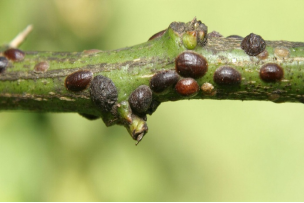
Source – https://primaagrotech.com/pest/scale-insect/
What are Scale Insects?
Scale Insects are sap-sucking Hemipteran pests in the superfamily Coccoidea. In citrus production, they are divided into two main categories:
- Soft Scales (e.g., Coccus hesperidum / Saissetia oleae): Characterized by a waxy, parchment-like protective upper skin [cite: 4]. They feed on plant sap, secrete honeydew, and foster black sooty mold fungus.
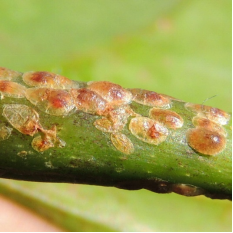
Coccus hesperidum
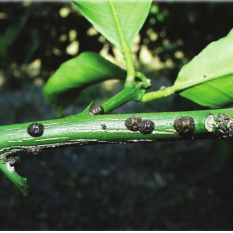
Saissetia oleae
Armored Scales (e.g., Aonidiella aurantii): Feature a hard, detachable waxy shield. They do not excrete honeydew but cause direct toxic cell collapse and tissue dieback.
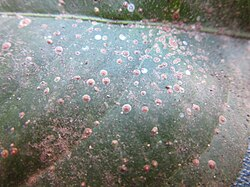
Typically classified as occasional pests under dryland conditions, scale insects commonly appear during summer months. They infest foliage, young twigs, and congregate heavily along stems and branches.
Life Cycle of Scale Insects
Larval/Crawler Deposit:
Mature females deposit live nymphs (crawlers) or eggs beneath their bodies daily over a period of one to two months.
Crawler Stage (1st Instar):
Tiny, mobile crawlers emerge from under the adult female cover to search for feeding sites on new twigs or leaves.
Critical Target Window: This active mobile phase lacks thick protective wax coatings, making it the most vulnerable stage for chemical or bio-rational control.
Nymphal Instars:
Once settled, crawlers insert piercing-sucking mouthparts into plant tissues and begin secreting protective waxy coverings.
Adult Stage:
Females: Wingless, dome-shaped, immovable, and protected by waxy parchment-like skin.
Males: Tiny, short-lived winged insects dedicated entirely to mating.
Generations: Multiple overlapping generations develop throughout the year.
- Under the dryland condition, brown scales can be seen occasionally during summer having waxy parchment-like upper skin.
- It infests foliage and young twigs and congregates on the branches.
- The mature female insect deposits larvae beneath her body each day for one to two months and several generations of scale develop during the year.
How Does It Damage the Plant?
- Direct Sap Depletion: Large congregations siphoning sap from leaves, twigs, and branches lead to leaf chlorosis, twig dieback, reduced tree vigor, and premature leaf drop.
- Sooty Mold Colonization: Soft scale excretions (honeydew) coat leaves and fruits, encouraging the growth of black sooty mold fungus which inhibits photosynthesis.
- Fruit Blemishing: High populations encrusting fruits cause cosmetic damage, discoloration, and devaluation of market yields.
Peak Activity Period
- Infestations spike in warm, dry weather conditions, particularly during late spring and summer months under dryland conditions.
Control Measures & Integrated Management
Modern IPM relies on timed treatments during peak crawler activity, controlling associated ant vectors, and conserving native biological agents.
- Cultural & Physical Practices
- Canopy Pruning: Prune out heavily infested internal branches to open the canopy to sunlight and air circulation, creating unfavourable microclimates for scale development.
- Ant Management: Ants protect soft scales from natural enemies in exchange for honeydew. Applying sticky bands or ant bait traps at the trunk base prevents ant access and allows natural predators to control scales.
- Mechanical Removal: Scrub branches on young trees or saplings using mild soap solutions to detach scale bodies.
- Biological Control
- Parasitoid Wasps: Micro-wasps such as Metaphycus helvolus (for soft scales) and Aphytis melinus (for armored scales) deliver high natural mortality rates.
- Predatory Beetles: Conserve native ladybird beetles (such as Chilocorus spp. and Lindorus lophanthae) and lacewings by avoiding broad-spectrum synthetic pyrethroids.
- Integrated Chemical Measures
Apply sprays when active mobile crawlers are observed on foliage before they build thick protective wax layers.
| Category | Chemical / Product | Recommended Rate | Application Notes & Mode of Action |
| Organic / Botanical | Neem Oil (1500 ppm) | 5 mL/L of water | Spray at fortnightly intervals. Acts as an oviposition deterrent and smothers crawlers. |
| Systemic Insecticide | Imidacloprid 17.8% SL | 0.5 mL/L of water | Applied as a foliar spray at fortnightly intervals or as a soil drench for systemic sap-uptake. |
| Horticultural Oil | Petroleum / Mineral Spray Oil | 10-15 mL/L(1.0 – 1.5 %) | Smothers all scale life stages physically without inducing chemical resistance. |
| Insect Growth Regulator (IGR) | Pyriproxyfen 10% EC or Buprofezin 25% SC | 1.0 mL/L | Inhibits nymphal molting and chitin development while protecting beneficial adult parasitoids. |
| Lipid Biosynthesis Inhibitor | Spirotetramat 150 OD | 1.0 – 1.2 mL/L | Fully 2-way systemic insecticide that moves into new growth flushes where scales feed. |
https://www.google.com/url?sa=i&url=https%3A%2F%2Fwww.flickr.com%2Fphotos%2Fiaea_imagebank%2F6922932505&psig
http://ppqs.gov.in/sites/default/files/approved_use_of_insecticides.pdf
http://eagri.org/eagri50/ENTO331/lecture18/cashew_003.html
http://ppqs.gov.in/sites/default/files/approved_use_of_insecticides.pdf
Mansour, R., et al. (2017). Scale insects and mealybugs (Hemiptera: Coccoidea) conducting damage in citrus orchards: Biology, ecology, and management strategies. Journal of Applied Entomology, 141(9), 701–718.
Grafton-Cardwell, E. E., & Vehrs, S. L. (1991). Inactivation and resistance management of scale insects (Coccoidea) in citrus using insect growth regulators and horticultural oils. Journal of Economic Entomology, 84(5), 1442–1449.
Directory of Plant Protection, Quarantine & Storage (PPQS). (2022). Major Uses of Pesticides Registered under the Insecticides Act, 1968 (Citrus IPM Guidelines). Ministry of Agriculture & Farmers Welfare, Government of India.