What is Citrus Leaf Miner?
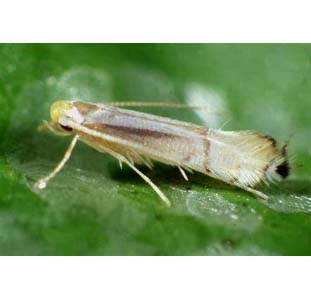
Phyllocmistes citrella, commonly known as Citrus Leaf Miner (CLM), is a small moth, whose larvae can cause considerable damage as they mine and feed upon immature citrus leaves.
 |  |
(Life Cycle – 30 – 60 Days)
Biology and Ecology-
- Egg– Female lays eggs singly on lower side of the newly emerging leaves mainly near the veins or midribs of the host plant. Female lay up to 50 eggs in her life span. Eggs are dome shaped and almost translucent. After 7 – 10 days, eggs hatch into neonate.
- Larvae– Larvae are 3 mm long with translucent greenish- yellowish appearance. There are four larval stages, the first three feeding on the epidermal cells immediately below the transparent cuticle. The fourth instar does not feed and produces silk to form the pupal chamber. The length of the larval stage has been found to range from 10 to 19 days. They are most devastating stage of citrus leaf minor.
- Pupae- The pupal stage occurs within the mines near the leaf margin, under a slight curl of the leaf. The pupal stage lasts from 8 to 20 days depending on temperature and then adults emerge in the morning hours.
- Adult– The adult leaf miner is a small, delicate, silver, and yellow-brown moth which, when at rest, measures approx. 2mm. There is a distinctive black dot on the tip of their forewing. They generally fly at dusk and hide in foliage during the daytime.
How does it damage the plant?
The most damaging stage of the insect is larval stage as they use their sharp blade-like toothed mandible to pierce the cell wall and feed upon epidermal cell sap. This results in serpentine mines which are filled their faeces. These mines usually end at the outer edges of leaves where larvae roll the leaf to protect the pupal chamber. Both young and old trees are affected but the damage to young plants is more serious.
Symptoms-
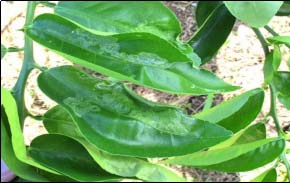
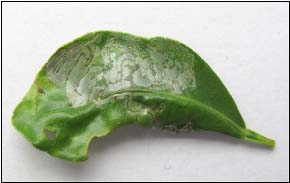
- The larvae make tunnels in the leaves tissue making zig zag pathway.
- Due to passage of air in this tunnels it looks silvery.
- The excreta of the pest make it look dark lined along those tunnels.
- The affected leaves become deformed, curl and defoliates later.
- The attacked plant looks sickly and cause severe defoliation.
The infested leaves also serve host for the Citrus canker.
- The infested leaves also serve host for the Citrus canker.
 |  |
| Source – Pestnet | Source – Pestnet |
| Fig – Symptoms of leaf miner | |
Severe Infection Period-
Usually leaf miner is more active during their growth period i.e., in spring and rainy seasons.
(Feb – March; June – July; October- November)
Management-
| Mechanical and Cultural Practice | Biological Control | Chemical Control |
| Avoid pruning during active growth period of the tree.Adventitious shoots should be pruned and burnt in summer to break the pest source, thereby, controlling infestation.Remove and dispose the affected leaves at the primary stage.Collection and destruction of fallen leaves and pruning of affected portion. | No predation of citrus leaf miner is known to occur.Spraying of Verticillium leccani @ 5 ml per liter at the time of the emergence of new leaves may control the leaf miner. | Foliar application: The insect can be satisfactory control by spraying of Abamectin 2% EC @ 1 ml per liter of water or Spinosad 45% EC @ 1 ml per liter. |
Source –
http://ppqs.gov.in/sites/default/files/approved_use_of_insecticides.pdf
http://eagri.org/eagri50/ENTO331/lecture18/cashew_003.html
http://ppqs.gov.in/sites/default/files/approved_use_of_insecticides.pdf